Agriculture and ICT: Two Sectors That Could Shape Africa’s Next Wealth Creation Era
By Clinton Mmbohere, CEO & Founder, PayzaAPI
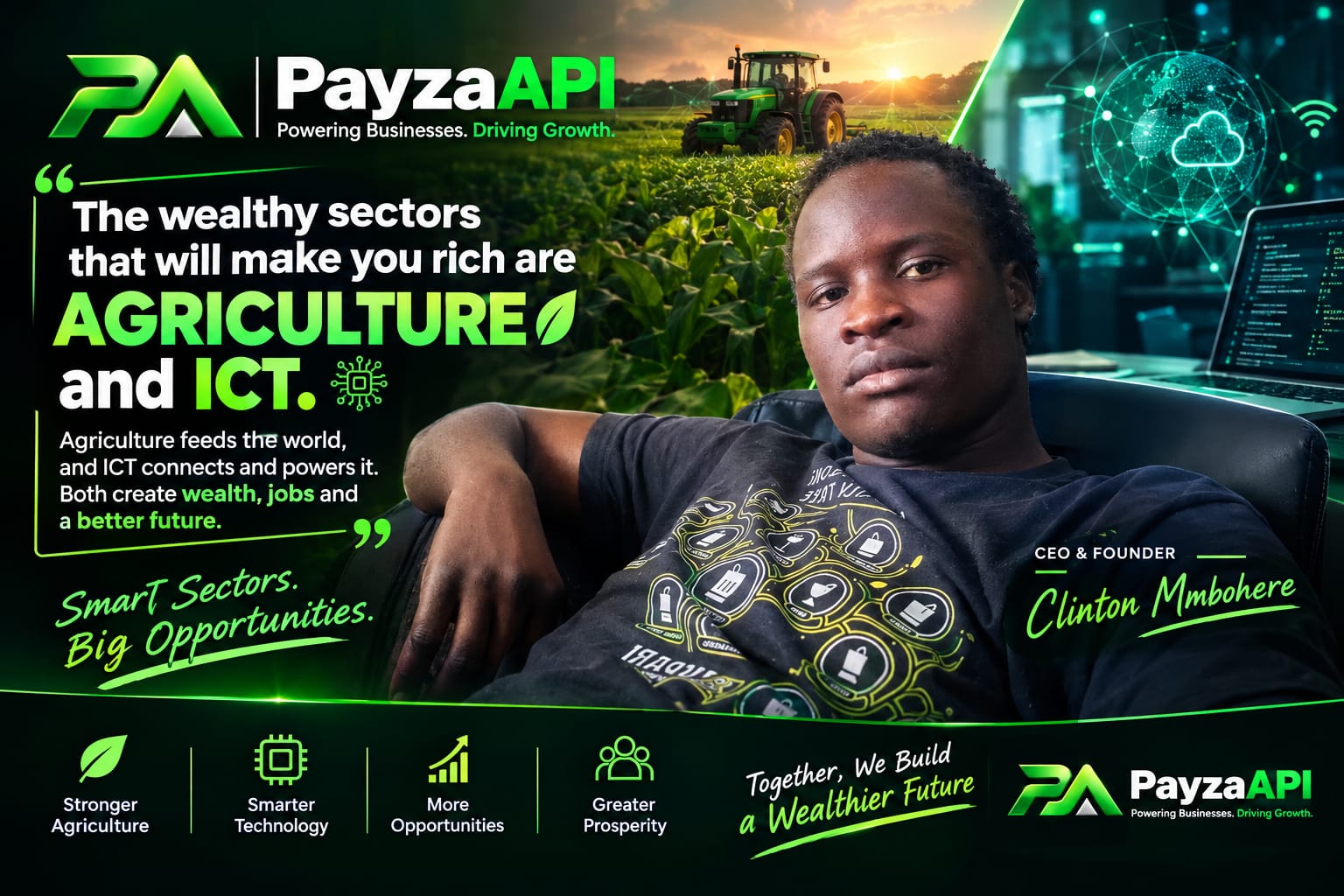
> “The wealthy sectors that will make you rich are Agriculture and ICT.”
That statement is deliberately provocative.
It does not mean that everyone who enters agriculture or ICT will automatically become wealthy. It means that, particularly in Africa, these two sectors sit on top of enormous and growing economic needs: food, technology, connectivity, financial services, logistics, data, automation and access to markets.
For young Africans thinking about entrepreneurship, investment and long-term wealth creation, the bigger question is not simply “Which business should I start?”
The better question is:
> “Which problems will millions of people continue paying to solve over the next 10, 20 or 30 years?”
Agriculture and ICT provide some compelling answers.
---
Agriculture: The Business of Feeding a Growing Population
Agriculture is sometimes viewed as an old-fashioned industry compared with technology startups, cryptocurrency or fintech.

That is a mistake.
Agriculture is not disappearing because technology is advancing. Agriculture is becoming more valuable because technology is changing how agriculture is produced, financed, marketed and distributed.
In Kenya, for example, the latest 2026 Economic Survey from the Kenya National Bureau of Statistics reports that agriculture, forestry and fishing accounted for more than 20% of the economy and grew by 3.1% in 2025.
The opportunity goes beyond farming itself.
Think about the entire agricultural value chain:
Seeds → farming → irrigation → machinery → fertilizers → harvesting → storage → processing → transport → marketplaces → financing → insurance → payments → exports.
There are businesses to build at almost every stage.
Agriculture is much bigger than growing crops
A young entrepreneur does not necessarily need to own 500 acres.
You could build a business around:
Farm inputs
Greenhouse farming
Irrigation
Agricultural machinery
Cold storage
Food processing
Agricultural logistics
Farm management software
Digital marketplaces
Agricultural financing
Export businesses
Poultry
Dairy
Horticulture
Aquaculture
Livestock
Agritech
The real opportunity is often adding value, rather than simply producing raw commodities.
Research published in Global Food Security in 2025 found that productivity-enhancing innovations in agrifood systems can generate positive income and employment effects, with improvements further along the value chain potentially producing even stronger employment and income effects.
That leads to an important lesson:
> Don't just ask, “What can I grow?” Ask, “What problem in the agricultural value chain can I solve?”

---
Africa Already Depends Heavily on Agrifood Businesses
The scale is enormous.
FAO estimates that almost 290 million people in Africa work in agrifood systems, and when related activities such as trade and transportation are included, agrifood systems account for approximately 62% of employment in Africa.
That means agriculture is not merely about farmers.
It includes the people who:
transport food,
process it,
package it,
sell it,
finance it,
insure it,
export it,
build technology for farmers,
provide machinery,
manage supply chains,
and connect producers with consumers.
This is why agriculture can be a powerful wealth-creation sector.
---
Then Comes ICT
If agriculture feeds the population, ICT increasingly connects, coordinates and enables the economy.
ICT means much more than computer repair or selling smartphones.
It includes:
Software development
Artificial intelligence
Fintech
Cybersecurity
Cloud computing
Data services
Digital payments
E-commerce
SaaS
Telecommunications
Digital marketing
Online education
Automation
Digital identity
Internet infrastructure
Business APIs
Mobile applications
And Africa's digital transformation is still in its relatively early stages.
The World Bank says digital technologies can create new pathways for economic growth, innovation, job creation and access to services across Africa.
Its Digital Africa research also found evidence that internet availability has positive effects on jobs and welfare, including through entrepreneurship, innovation and foreign investment.
---
Kenya Shows Why ICT Matters
Kenya has already demonstrated what happens when technology meets real economic needs.
The World Bank reported that Kenya's ICT sector grew by an average of 10.8% annually from 2016 in its analysis of the country's digital economy, describing ICT as an increasingly important source of economic development and job creation.
More recently, KNBS reported that Kenya's Information and Communication sector grew by 4.8% in 2025.
The lesson is not that technology is guaranteed to make everyone rich.
The lesson is that digital infrastructure creates opportunities for people who can solve real problems with it.
---
The Interesting Part: Agriculture + ICT
This is where the opportunity becomes even more interesting.
Agriculture and ICT don't have to compete.
They can work together.
Imagine an agricultural company using:
IoT sensors to monitor farms
AI to identify crop diseases
mobile payments to pay farmers
digital marketplaces to find buyers
GPS to optimize logistics
cloud software to manage operations
digital credit to finance farmers
data analytics to forecast demand
Now you aren't simply running a farm.
You are building an agritech ecosystem.
And this is exactly why I believe entrepreneurs should stop thinking about industries in isolation.
The biggest businesses may exist between industries.
---
Look at the People Who Saw the Technology Opportunity
Consider Strive Masiyiwa.
He built his wealth primarily through telecommunications and technology. Forbes describes him as the founder of Econet Wireless Zimbabwe and notes his interests across telecoms, fintech and digital infrastructure.
Econet itself describes its business as a technology-focused group built around using technology to address everyday consumer and business needs across Africa.
The important lesson isn't simply:
“Become the next Strive Masiyiwa.”
It is:
> Identify a fundamental need, then build infrastructure around solving it.
Communication was once expensive and inaccessible.
Technology changed that.
Today, entrepreneurs have similar opportunities in payments, digital commerce, artificial intelligence, logistics and financial infrastructure.
---
Tony Elumelu Shows Another Side of the Opportunity
Tony Elumelu provides another interesting example because his investments have crossed multiple strategic sectors.
His investment portfolio includes areas such as financial services, power, energy, technology and agribusiness.
He has repeatedly emphasized long-term investment, execution and building businesses around Africa's economic needs.
This is particularly relevant to our discussion because it demonstrates that wealth creation does not necessarily mean choosing one industry and ignoring everything else.
It can mean identifying several sectors that support one another.
For example:
Agriculture + Energy + Technology + Finance + Logistics
can become a much larger opportunity than agriculture alone.
---
The Future Belongs to People Who Build Infrastructure
One of the biggest lessons I see from successful African businesses is this:
> Don't only sell products. Build the infrastructure that helps other people sell products.
Consider what happens when you build:
a payment platform,
a logistics network,
agricultural infrastructure,
cloud software,
a marketplace,
a data platform,
an API,
or a communications network.
You are potentially enabling thousands or millions of other businesses.
That creates a powerful business model.
And this is also where the philosophy behind PayzaAPI comes from.
PayzaAPI is built around the idea that businesses should have access to payment infrastructure that allows them to transact, integrate and grow more efficiently.
Powering Business. Driving Growth.
---
Why Digital Payments Matter to Agriculture
Think about a farmer selling produce to a buyer in another region.
Without good payment infrastructure, the transaction can become complicated.
But with digital payments, businesses can potentially:
Sell → collect → reconcile → pay suppliers → track transactions → scale.
The same infrastructure can support:
e-commerce companies,
agricultural businesses,
schools,
logistics companies,
SaaS companies,
digital product sellers,
marketplaces,
and service businesses.
This is why fintech and payment infrastructure can become an important layer underneath Africa's digital economy.
---
Don't Chase "Quick Money"
There is another lesson behind this advice.
When I say agriculture and ICT can create wealth, I am not saying:
> “Put your money into agriculture today and become rich tomorrow.”
That mindset can be dangerous.
Real wealth is usually built through:
Knowledge + execution + patience + ownership + reinvestment.
The people who become successful in these sectors are often solving difficult problems for a long period.
Strive Masiyiwa's journey is a good example. He faced years of resistance before launching Econet Wireless Zimbabwe and ultimately built a major technology group.
Tony Elumelu's investment philosophy similarly emphasizes long-term investment, execution and resilience.
The common denominator isn't a magic industry.
It's execution over time.
---
What Should Young Entrepreneurs Do?
If you're starting from zero, don't immediately think:
“I need millions of shillings.”
Start with:
1. Learn
Understand the industry before investing heavily.
2. Identify a painful problem
People pay more readily to solve painful problems.
3. Start small
Test the idea before committing everything.
4. Use technology
Even traditional businesses can become more efficient through software, digital marketing, payments and data.
5. Build systems
A business that depends entirely on the founder's personal effort is difficult to scale.
6. Reinvest
Don't consume every profit.
Use profits to acquire equipment, technology, land, skills, people and distribution.
7. Think beyond your town
Africa is a massive market.
Digital technology makes it increasingly possible for an entrepreneur to serve customers far beyond their physical location.
---
The Bigger Opportunity Is Not Agriculture OR ICT
Perhaps the most important correction to my original quote is this:
The future isn't Agriculture versus ICT.
It is:
> Agriculture powered by ICT.
Imagine a farmer who can access market prices from a phone.
A cooperative that digitally pays thousands of farmers.
An exporter that tracks its entire supply chain digitally.
A fintech company that provides payment infrastructure for agricultural marketplaces.
A logistics company that uses data to optimize food distribution.
A software company that helps farms manage inventory and workers.
That's where agriculture and technology converge.
---
Africa's Digital Opportunity Is Still Huge
The World Bank reports that more than 160 million Africans gained broadband internet access between 2019 and 2022, while digital technologies continue to create opportunities for economic growth, innovation and jobs.
Its more recent work also points to the enormous potential of digital transformation for Africa's future workforce and economic development.
This means entrepreneurs entering technology today aren't necessarily arriving at the end of the opportunity.
In many areas, the infrastructure is still being built.
---
My Advice to the Next Generation
If you're young and wondering where to put your energy, don't simply follow whatever business is trending on social media.
Look at the fundamentals.
Ask yourself:
What will people always need?
Food.
What will businesses increasingly need?
Technology.
What connects businesses to customers?
Digital infrastructure.
What helps businesses transact?
Payments.
What makes businesses scalable?
Systems.
That's where I believe some of Africa's most interesting opportunities will emerge.
---
Final Thought
Agriculture gives us food, raw materials and enormous value chains.
ICT gives us connectivity, automation, information and scale.
Combine the two and you begin to see something much bigger:
An African economy where technology doesn't replace traditional industries — it makes them more productive, connected and scalable.
So when I say:
> “The wealthy sectors that will make you rich are Agriculture and ICT,”
I'm not promising anyone a shortcut to wealth.
I'm pointing toward sectors where fundamental human needs, economic activity and technological transformation intersect.
The opportunity belongs to those willing to learn, build, solve real problems and stay consistent.
Agriculture feeds the world.
ICT connects the world.
Entrepreneurship turns opportunity into value.
— Clinton Mmbohere
CEO & Founder, PayzaAPI
Powering Business. Driving Growth.
---
SEO keywords to target
Primary keyword: Agriculture and ICT in Africa
Secondary keywords:
best sectors to invest in Africa
profitable businesses in Kenya
agriculture business opportunities in Kenya
ICT business opportunities in Africa
technology and agriculture
agritech Africa
digital economy Africa
wealth creation in Africa
profitable sectors in Kenya
future of agriculture in Africa
future of ICT in Africa
African entrepreneurship
technology businesses in Kenya
digital payments Africa
fintech Africa
Suggested SEO title:
Agriculture and ICT: The Two Sectors That Could Create Africa's Next Generation of Wealth
Suggested meta description:
Discover why agriculture and ICT could be among Africa's biggest wealth-creation opportunities, with evidence from Kenya, the World Bank, FAO and successful African entrepreneurs.
Suggested URL slug:
/agriculture-ict-africa-wealth-creation
Suggested social headline:
> 🌍 Want to Build Wealth in Africa? Look at Agriculture + ICT.
One feeds the world. The other connects it. The biggest opportunity may be where the two meet.