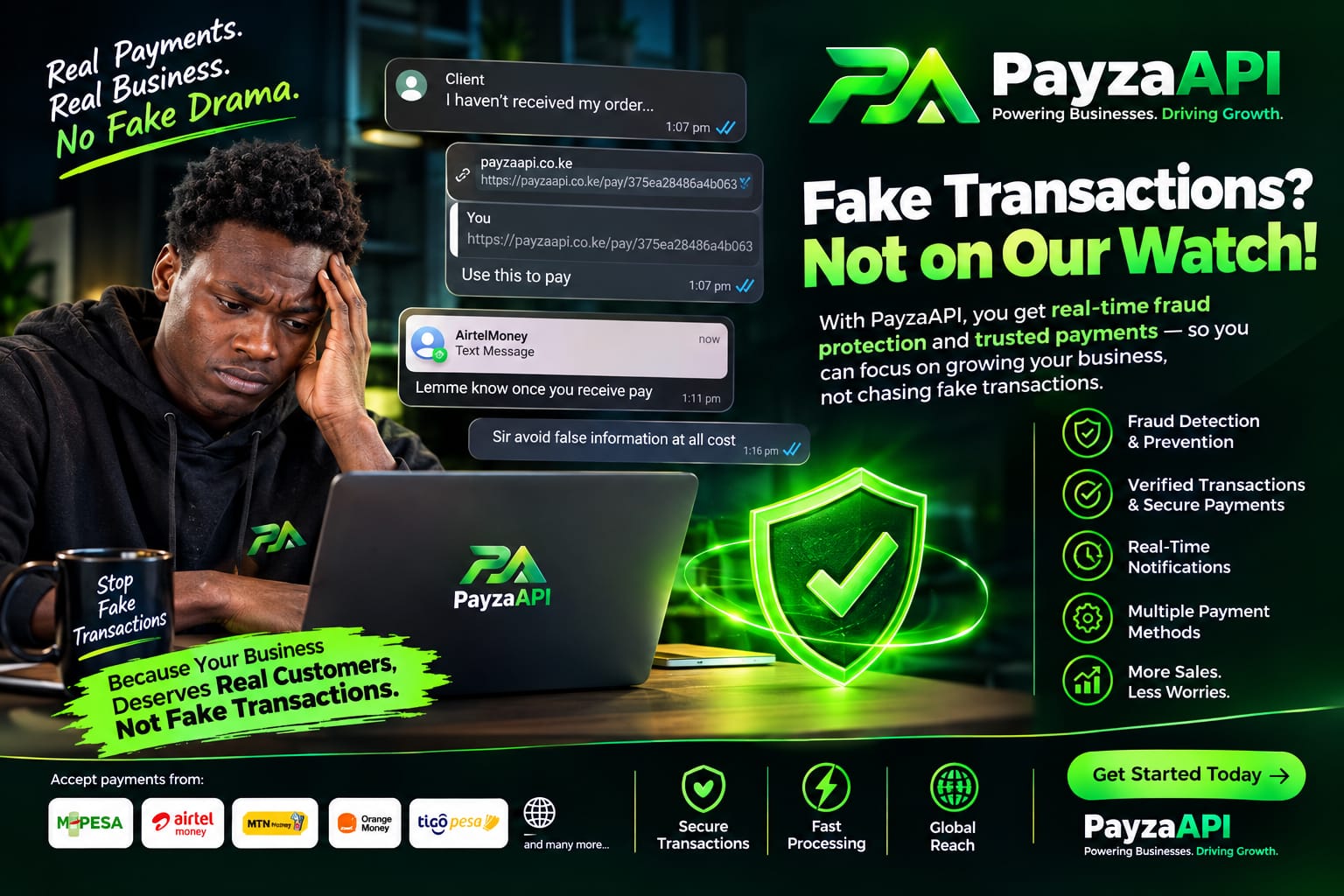
By Clinton Mmbohere, CEO & Founder, PayzaAPI
In today’s digital economy, accepting payments has become easier than ever. A customer can place an order, receive a payment link, complete a mobile-money transaction and expect their product or service almost immediately.
But there is another side to this convenience: fake payment claims.
A customer may send a screenshot claiming that they have paid. They may forward a message that appears to come from a mobile-money provider. They may even insist that the money has already been sent and ask the merchant to release the product.
Unfortunately, a screenshot is not money.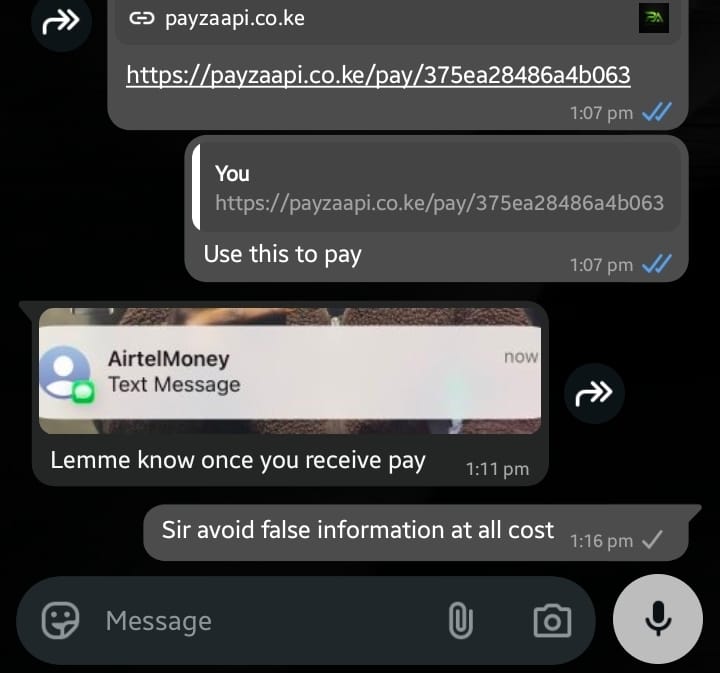
A forwarded SMS is not necessarily proof of payment.
And a customer's confidence does not make a transaction genuine.
This is exactly why modern businesses need proper payment verification infrastructure.
The Growing Problem of Digital Payment Fraud
Kenya has become one of the world's most developed mobile-money markets. The Central Bank of Kenya's latest published mobile-money statistics show 94.35 million registered mobile-money accounts in July 2026, with agent cash-in/cash-out activity worth approximately KSh 728.7 billion that month alone. �
Central Bank of Kenya
With such enormous transaction volumes, digital payments are now deeply integrated into everyday commerce.
But the more businesses depend on digital payments, the more important trust and verification become.
The Central Bank of Kenya has previously identified fraud—including socially engineered fraud, SIM-swap fraud and identity theft—as a threat to trust in digital payments. Its National Payments Strategy also noted that businesses had identified significant fraud concerns around mobile-money and card payments. �
Central Bank of Kenya
This tells us something important:
Payment convenience without proper verification can create serious business risk.
The Classic Fake Payment Scenario
Imagine you run an online store.
A customer wants to purchase a product worth KSh 5,000.
You send them a payment request.
A few minutes later, they send you a screenshot.
Customer:
"Paid. Please send the product."
The screenshot appears convincing.
It contains:
A transaction message
An amount
A phone number
A transaction reference
A timestamp
The merchant looks at it and thinks:
"The customer has paid."
The product is released.
But later, the merchant checks the account.
Nothing came in.
The screenshot was fake, manipulated, edited, recycled from another transaction, or otherwise did not represent a successful payment to the merchant.
Now the merchant has lost the product and the money.
This is one of the reasons businesses should never make fulfilment decisions solely based on screenshots supplied by customers.
A Screenshot Is Evidence of a Message — Not Proof of Settlement
This distinction is extremely important.
A screenshot only proves that someone has shown you an image.
It does not independently prove that your payment system received the money.
Think about it this way:
Screenshot-based verification
Customer → Screenshot → Merchant → Trust customer → Release product
There is a weak verification point in the middle.
System-based verification
Customer → Payment Gateway → Payment Provider → Verification → Merchant System → Release product
The second approach is considerably stronger because the merchant's system can rely on transaction status rather than simply trusting what the customer claims.
This is the direction modern payment infrastructure should take.
This Is Where PayzaAPI Comes In
At PayzaAPI, the philosophy is simple:
Don't trust the screenshot. Verify the transaction.
PayzaAPI is designed as a payment infrastructure platform that allows businesses to integrate payment collection into their websites, applications and platforms.
According to PayzaAPI's current API documentation, merchants can initiate payments through the API and receive payment results through webhooks, while the transaction can also be checked through a dedicated verification endpoint. �
Payza
That changes the merchant's workflow.
Instead of asking:
"Has the customer sent me a screenshot?"
The business can ask:
"What does the payment system say about this transaction?"
That is a much better question.
How Payment Verification Should Work
Consider a typical online purchase.
Step 1: Customer places an order
The customer selects a product and proceeds to checkout.
Step 2: Your system creates a payment
Your website sends the payment request to PayzaAPI.
The transaction receives a unique reference.
Step 3: Customer makes the payment
Depending on the payment method, the customer completes the payment through the available payment channel.
Step 4: Payment status is received
PayzaAPI's API supports webhook notifications for completed payments. The merchant's server can receive the transaction result and process the order accordingly. �
Payza
Step 5: Your system verifies the transaction
PayzaAPI also provides a verification endpoint that allows the merchant's system to check the current status of a transaction. �
Payza
Step 6: Product is released
Only after the payment is confirmed should the merchant automatically:
Deliver a digital product
Activate an account
Release an order
Increase a customer's balance
Provide access to a course
Confirm a subscription
Process another service
This is where automation becomes extremely valuable.
The Golden Rule for Online Merchants
Never fulfil an order because a customer says "I have paid."
Fulfil the order because your payment system confirms that the transaction succeeded.
There is a major difference.
A customer saying:
"I paid."
is a claim.
Your payment system reporting:
Payment: SUCCESS
is a system event that your software can act upon.
That distinction can save businesses significant losses.
What About Fake PayzaAPI Payment Links?
Payment links themselves can also be abused if merchants do not understand how their payment system works.
For example, someone might send a merchant a payment URL and claim:
"I have already paid through this link."
But opening or sharing a payment link does not necessarily mean that payment has successfully settled.
A payment can be:
Pending
Successful
Failed
Cancelled
PayzaAPI's verification documentation explicitly defines these transaction states. �
Payza
Therefore, merchants should distinguish between:
Payment initiated
and
Payment successfully completed.
Those are not the same thing.
Why Real-Time Verification Matters
Imagine you sell digital products.
A customer pays KSh 2,000.
If your system automatically delivers the product based on a screenshot, a fraudster could potentially receive the product without paying.
But if your system waits for a confirmed successful transaction, the process becomes much more controlled:
Order Created
↓
Payment Requested
↓
Customer Pays
↓
Payment Verified
↓
Order Confirmed
↓
Product Delivered
This is the kind of architecture businesses should aim for.
It Is Not Just About Fraud
Payment verification is also about operational efficiency.
Without automated verification, merchants may constantly have to ask:
"Did you pay?"
"Send the transaction message."
"Send the screenshot."
"What time did you pay?"
"Which number did you use?"
"Let me check."
"Give me five minutes."
"I haven't received it yet."
This creates unnecessary friction.
Customers become frustrated.
Merchants waste time.
Support teams become overloaded.
And the business looks less professional.
Automated payment verification can reduce this manual work by allowing software to handle transaction status and order fulfilment.
Building Trust Between Customers and Businesses
There is another important benefit.
When customers know that a business has a professional payment system, the purchasing experience becomes more trustworthy.
Instead of sending money and then having to prove payment manually, customers can interact with a structured checkout process.
The merchant also receives a consistent transaction reference and payment status.
This creates a better digital experience for both parties.
The Central Bank of Kenya has emphasized trust, security, usefulness, choice and innovation as important principles for the country's payment ecosystem. �
Central Bank of Kenya
That is exactly the direction businesses should be moving toward.
The Cost of Believing Every Payment Screenshot
Let's consider a simple example.
Suppose an online merchant sells a digital product for KSh 3,000.
The merchant receives five fake payment claims every week.
If the merchant mistakenly releases one product per week:
KSh 3,000 × 52 weeks = KSh 156,000
That is potentially KSh 156,000 worth of annual leakage from a single repeated mistake.
And that calculation doesn't include:
Physical products
Delivery costs
Staff time
Customer-support costs
Chargebacks
Refund disputes
Reputation damage
Lost opportunities
For a business processing hundreds or thousands of transactions, the exposure can become much larger.
Merchants Need a "Verify Before Fulfil" Culture
Technology alone is not enough.
Businesses should also establish internal rules.
For example:
Rule 1 — Never trust screenshots alone
Screenshots can be useful for troubleshooting, but they should not be the final authority for fulfilment.
Rule 2 — Use transaction references
Every payment should have a unique reference that can be traced.
Rule 3 — Verify payment status
Your application should confirm that the transaction is actually successful.
Rule 4 — Automate fulfilment
Once a confirmed payment event arrives, your system can automatically trigger the next action.
Rule 5 — Keep transaction records
Maintain logs for:
Reference
Amount
Currency
Customer
Payment status
Timestamp
Gateway
Order ID
Rule 6 — Protect API credentials
PayzaAPI's documentation specifically advises merchants to keep their secret API key private and never expose it in frontend JavaScript. �
Payza
Security is not only about detecting fraudulent customers. It also includes protecting the infrastructure that processes legitimate payments.
PayzaAPI: Moving Businesses From "Trust Me" to "Verify It"
This is one of the bigger ideas behind modern payment infrastructure.
Traditional informal commerce often operates on:
"Trust me, I have paid."
Professional digital commerce should operate on:
"Let's verify the transaction."
That is a completely different mindset.
PayzaAPI provides API-based payment infrastructure that allows merchants to integrate payment collection into their systems rather than manually handling every payment confirmation. Its current documentation describes support for payment initiation, hosted checkout, webhooks, transaction verification and other payment-related APIs. �
Payza
The goal is not simply to move money.
The goal is to help businesses build reliable payment workflows around that money.
A Payment Gateway Should Be More Than a "Pay Button"
A modern payment platform should help businesses answer important questions:
Was the payment initiated?
Was it successful?
What amount was paid?
Which transaction does it belong to?
Has the transaction already been processed?
Can my system automatically fulfil the order?
Can I reconcile my transactions later?
This is why payment infrastructure matters.
The payment button is only the visible part.
Behind it is an entire ecosystem of:
Authentication
Transaction processing
Verification
Webhooks
Reconciliation
Security
Reporting
Customer management
Refund workflows
Payouts
Fraud controls
PayzaAPI's API documentation currently includes capabilities beyond basic payment initiation, including refunds, payouts, customers, subscriptions, POS functionality, invoices and webhook logging. �
Payza
What Merchants Should Do Today
If you operate an online business, ask yourself these five questions:
1. Do I release products based on screenshots?
If yes, reconsider your process.
2. Can my website automatically confirm successful payments?
If not, payment automation should be a priority.
3. Does every transaction have a unique reference?
If not, reconciliation can become difficult.
4. Can I verify a transaction independently?
A proper payment architecture should provide a way to determine transaction status.
5. Is my payment infrastructure designed to scale?
A business processing 10 transactions per day and one processing 10,000 transactions per day cannot rely on the same manual processes.
The Future Is Automated
As African e-commerce continues to grow, payment infrastructure will become increasingly important.
The Central Bank of Kenya describes retail payment systems—including mobile money and card payments—as important infrastructure for e-commerce and commercial activity, while emphasizing safety and efficiency. �
Central Bank of Kenya
That means the future of digital commerce isn't simply about giving customers more ways to pay.
It is also about making sure businesses can reliably know when they have been paid.
And that requires proper infrastructure.
Final Thoughts
There will always be people who try to take advantage of weaknesses in payment processes.
Some will manipulate screenshots.
Some will forward old messages.
Some will claim that a transaction is pending.
Others will pressure merchants into releasing products before payment confirmation.
But businesses don't have to fight these problems manually.
Technology can help.
The right payment architecture can turn payment verification from a manual conversation into an automated system process.
Instead of:
"Bro, I have paid. Check the screenshot."
The business system should be able to say:
"Transaction verified. Payment successful. Order approved."
That is the difference between trusting a claim and verifying a transaction.
And that is why businesses need modern payment infrastructure.
PayzaAPI — Powering Businesses. Driving Growth.
Don't trust the screenshot. Verify the payment.
Explore PayzaAPI Developer Documentation�
SEO Details
SEO Title:
Fake Payment Transactions: How Businesses Can Verify Payments and Prevent Fraud
Meta Description:
Learn how fake payment screenshots and false transaction claims can hurt businesses, and discover why automated payment verification, webhooks and transaction status checks are essential for secure digital commerce.